Marketing

When to Trust a Customer's Stated Alternative

Antonio Evans10 min read

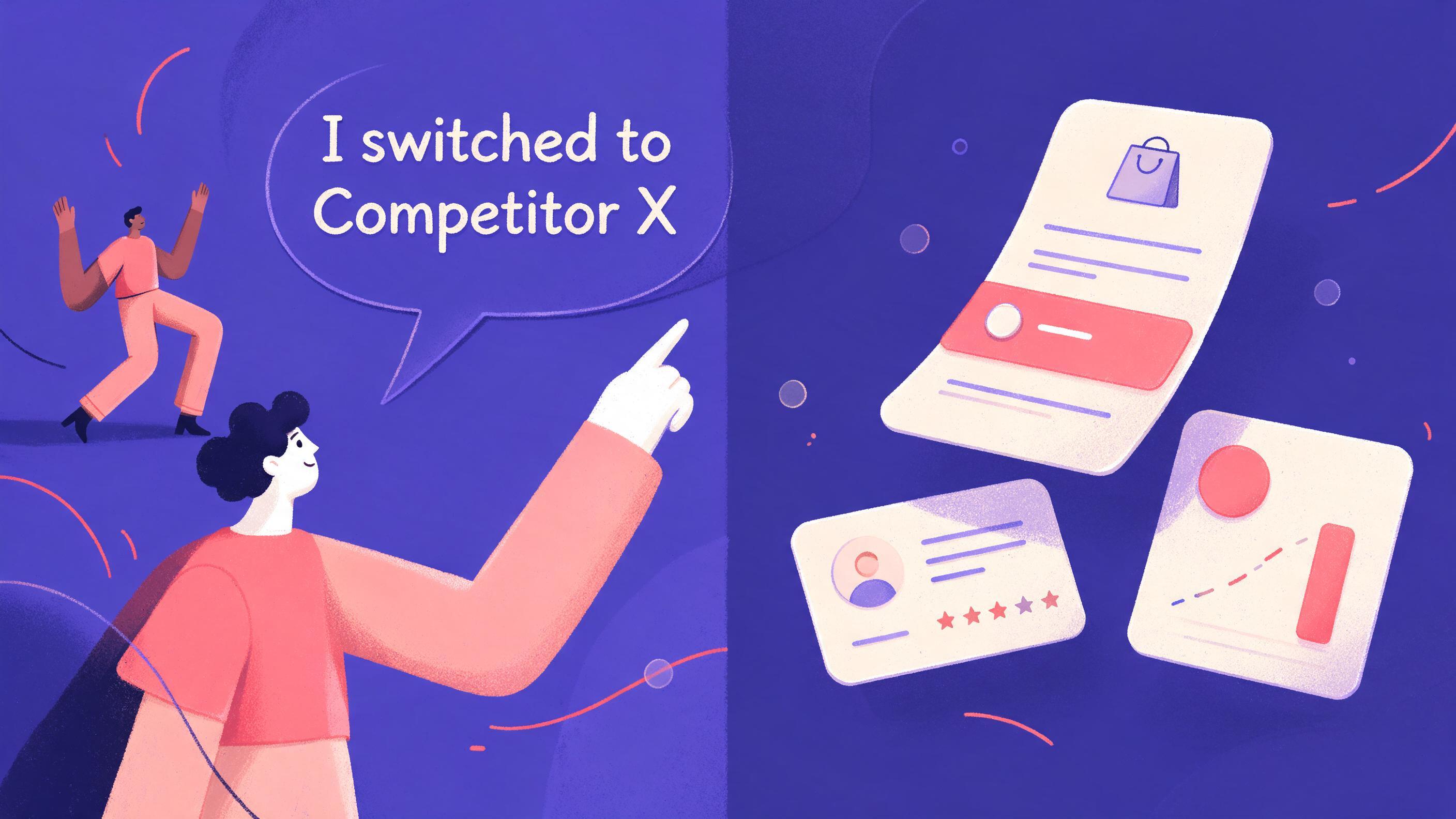
A split-screen illustration: on the left, a customer speaking with a speech bubble showing 'I switched to Competitor X'; on the right, three evidence cards: a receipt with a highlighted line.
Key points

Key points

  1. 1Trust a customer's stated alternative only when it names a specific competitor, time and price and can be checked against a receipt, screenshot or calendar entry.
  2. 2Stated research predicts actual purchase behavior far less accurately than observed behavior does, so words alone are a weak basis for decisions.
  3. 3Receipts, app screenshots and calendar entries turn a verbal claim into a testable record you can compare across customers.
  4. 4When evidence is missing, log the claim as a hypothesis and design a small test instead of rewriting a roadmap or a sales pitch.

Why stated alternatives drift from reality

A customer tells you they "used to use" a competitor, "almost signed" with someone else, or "tried the free version" last month. Every one of those phrasings bundles a memory, a self-image and an educated guess. The memory is reconstructed at the moment of the question, not retrieved like a file. The self-image pushes toward the answer that sounds reasonable and diligent. The guess fills the gaps.

Economists have a name for the gap. A stated preference is what someone says they prefer or did, while a revealed preference is what their behavior shows, and where the two diverge the behavior is the truer signal (Koji, stated vs revealed preferences). The idea goes back to Paul Samuelson, who argued we should infer value from choices actually made rather than from claims (Koji).

The size of the gap is not a rounding error. One practitioner summary reports that traditional stated-preference research predicts purchase behavior with roughly 34% accuracy, while behavioral methods reach as high as 89% when properly implemented, and that about 38% of online shoppers act differently from what they previously stated (Koji). Treat those numbers as directional rather than precise, but the direction is consistent: words are cheap, behavior is expensive.

Academic work reaches the same conclusion from a different angle. A review of the reported-versus-revealed preference literature notes that reported answers mislead when respondents do not remember past behavior, do not understand the question, or answer inaccurately, which is exactly the condition of a fast sales call (CEPR VoxEU). The same review found that qualitative reports did carry real information about spending on stimulus payments, just less than observed behavior, which is the useful nuance: reports are not noise, they are weak evidence that needs corroboration (CEPR VoxEU).

Three forces that corrupt a stated alternative

ForceWhat happens in the conversationWhat the customer saysWhat often happened
Memory reconstructionThey rebuild the timeline from fragments"We tried that about six months ago"A demo, a free trial, or a colleague's mention
Social desirabilityThey want to look diligent and well-informed"We compared three vendors"They looked at one pricing page
Substitution biasThey name the nearest familiar brand"It's basically like X"It solved a different job at a different price

Substitution bias deserves its own paragraph. Buyers classify your product into the nearest category they already hold in their head, because the category is the frame that determines the comparison set and the budget line the purchase comes out of (10Louder). When a customer says their alternative was "a spreadsheet" or "the incumbent," they may be telling you which budget they think you belong to, not which product they actually evaluated. That is a positioning signal dressed up as a behavioral one.


The decision rule

Here is the rule in one line: trust a stated alternative only when it is both specific and verifiable. Otherwise, treat it as a hypothesis.

Specific means it names a competitor, a time and a price. "We looked at a few options" fails on all three. "We paid Acme $2,400 for an annual plan that renewed in March" passes on all three. Verifiable means a receipt, screenshot or calendar entry exists that would confirm or contradict the claim.

The four combinations behave very differently, and the mistake most teams make is collapsing them.

VerifiableNot verifiable
SpecificAct on it. Log the evidence and look for the same pattern across accounts.Probe once. Ask for the artifact without pressure; if none exists, downgrade to a hypothesis.
Not specificAsk for detail. The existence of a receipt usually means the details are recoverable.Ignore as evidence. Treat it as small talk, or as a hint about how the customer categorizes you.

Two practical corollaries follow. First, never let an unverified claim enter a roadmap, a pricing decision or a positioning statement without a label. Second, a lack of evidence is itself a finding. A customer who cannot produce any trace of a claimed evaluation may be describing an aspiration rather than a history, and that distinction changes what you should build.

This matters because positioning statements and value propositions are decisions that rest on claims about alternatives. A positioning statement says who you serve, what category you compete in, and what you do that the alternatives cannot, and it needs a proof line stating the reason a buyer should believe it (Wit & Craft). If the "alternatives" in that sentence come from unverified interviews, you have written a confident sentence about a market that may not exist in the form you imagine.

Evidence type one: receipts

A receipt is the strongest evidence because it cost the customer something. That is the principle behind the currency of commitment: an email sign-up, a pre-order, a completed task or a payment weighs far more than verbal enthusiasm (Koji).

What counts as a receipt:

  • Order confirmations and invoices, including the renewal date and amount
  • Bank or card statements showing a vendor charge
  • Procurement records or purchase orders
  • A cancellation confirmation, which proves a relationship existed and ended

Ask for these late in the conversation and without pressure. "Do you happen to have the invoice handy? I want to make sure I understand what you were paying for." People who genuinely paid usually can find it, and the act of looking often surfaces details they had compressed.

The evidence also protects you from a specific failure mode: a claimed competitor price that becomes the anchor for your own discounting. A quoted price is a number a reader can check, so it should be checked. If a customer says they were paying $500 a month and the invoice says $150, you have learned something about how they budget, not just about the competitor.

Procurement and finance teams already think this way. Fraud detection systems monitor every invoice rather than a sample, flag anomalies in amounts and sequences, and score vendors for risk before payment (apexanalytix). You do not need that machinery, but the underlying habit is transferable: look at the transaction, not the description of the transaction.

Evidence type two: screenshots

Screenshots cover the middle band of evidence. They are cheap to produce, easy to fake, and usually honest if requested in the right way. They answer questions about usage and abandonment that no interview answer resolves.

Useful screenshots:

  • App or account screens, showing the last login date or the plan tier
  • Browsing history filtered to a vendor's domain
  • Chat logs with a competitor's support team
  • A pricing page the customer annotated during evaluation
  • A saved comparison spreadsheet

The strongest single artifact in this category is the abandonment trail: a sign-up confirmation followed by a last-login date three days later. That pattern tells you the customer tried the alternative and it failed, which is a very different story from "we evaluated it and chose not to proceed."

Ask about past behavior, not future intentions. "Tell me about the last time you faced this problem, what did you actually do" recovers revealed behavior through the interview itself, whereas "would you use this" invites a cheap, flattering yes (Koji). The product manager's version of the same idea is to start every interview with the current process, then ask what the person has already done to improve it and whether that worked (Alisa Works).

One caution: do not accept a screenshot as proof of value. A customer who screenshotted a dashboard may have used it once. Screenshots establish activity; receipts establish commitment; calendar entries establish intent over time.

Evidence type three: calendar entries

Calendar entries are the most underused evidence, because they carry dates, durations and recurrence. They answer the question that trips up most alternative claims: when, and for how long.

High-value entries:

  • The kickoff or evaluation meeting with the competitor
  • A recurring sync that implies an ongoing relationship
  • The renewal reminder the customer set
  • A cancellation or offboarding meeting
  • A trial end date

Two patterns are worth recording. The first is duration: an evaluation that spanned three months with four meetings is a serious alternative, while a single 30-minute demo is a data point. The second is the follow-through: a customer who put a renewal reminder on their calendar was planning to keep paying, and a customer who did not was probably letting it lapse.

Calendar evidence also disciplines your own team. If your sales notes say an account "seriously evaluated a competitor in Q1" and the calendar shows one call in March, your notes were describing enthusiasm rather than process. That mismatch is common enough that it is worth a periodic audit of your own CRM fields against artifacts.

How to ask so the answer is checkable

The questioning technique is doing most of the work here, and it is learnable. The core rule from customer development is to keep your own idea out of the conversation, because once you start thinking about your idea your interpretations skew toward validation and the person across the table, wanting to be helpful, supplies it (Cindy Alvarez via Customer Dev Labs). That desire to be helpful is one of the documented drivers of the say-do gap (Koji).

A workable sequence:

  1. Process. "Walk me through how you handle this today, step by step."
  2. History. "When did you last change how you do it? What did you switch from?"
  3. Specifics. "Which product, what did it cost, when did it start and stop?"
  4. Artifact. "Do you have the invoice, the confirmation email or the calendar invite? I want to get the details right."
  5. Consequence. "What happened after it ended? What did you do the following week?"

Step five is the one teams skip, and it is where substitution bias shows up. A customer who went back to a spreadsheet after trying a tool has told you the tool did not clear the bar, which is better information than any satisfaction rating.

Follow-up questions deserve planning rather than improvisation. The difference between a vague answer and a checkable one is usually a single well-placed follow-up about what happened next or what the person did instead (BetterFeedback). Survey designers make the same point: the question that asks what your company could do better produces opinions, while the question that asks what changed for the customer produces history (SurveyMonkey).

A worked example with numbers

Suppose ten customers in a quarter tell your team that their alternative was "a competitor's analytics tool." Here is how the rule plays out.

You ask for specifics and artifacts in a short follow-up email. Results:

Artifact foundAccountsWhat it tells you
Invoice with a renewal date4Real, paid, dated alternative. Note price and term.
Trial screenshot, last login within a week2Evaluated but abandoned. Ask why.
Calendar invite to a demo only2Considered but never committed. Weak signal.
Nothing, after two gentle asks2Treat as hypothesis. Do not cite in strategy.

Now the arithmetic that matters. If your team had taken all ten at face value, it would have concluded that a competitor's tool is the dominant alternative in this segment and priced or positioned against it. The evidence says four customers had a paid relationship, two abandoned a trial, two saw a demo and two produced nothing. The real competitive threat is narrower and the abandonment pattern (two of six who engaged) suggests a specific objection you can test.

Second piece of arithmetic: the two abandoned trials are where the insight lives. Each represents a customer who wanted the job done badly enough to start and did not finish. That is not a pricing story, it is a fit story, and it is invisible in the original ten statements.

Run this on every claim that would change a decision. A claim that changes nothing can stay unverified.

When stated alternatives are still worth listening to

Revealed preference is more reliable, but stated preference is the only option in three situations: when the product or category does not exist yet, when you need the why behind an observed behavior, and when you are measuring attitudes such as trust or frustration that have no clean behavioral proxy (Koji). Stated data is also the natural tool for hypothetical scenarios such as a product that has never shipped (The Structural Econ Guy).

So the rule is not "ignore what customers say." It is "classify it correctly." A stated alternative about a product that does not exist is a hypothesis with no possible receipt, and the right move is a small test with a real cost attached: a deposit, a pilot commitment, a scheduled onboarding call. A stated alternative about a product that does exist should have an artifact, and if it does not, that absence is information.

There is a useful parallel in category strategy. If prospects keep asking what category you are in, or keep comparing you to solutions that solve a different problem, the market has not placed you yet, and the fix is a sharper position rather than more interviews (10Louder). That is a case where what customers say about alternatives should change your positioning, because the claim is about their confusion, which is observable, rather than about their history, which is not.

For teams that want to run this at scale, the work is mostly plumbing: a field in the CRM for the named alternative, a checkbox for which artifact was seen, and a report that separates verified from unverified claims. If you would rather hand the sorting and summarizing to something that reads your notes and produces the comparison table, Quanta Experts can take that on at https://quantaintelligence.ai/agents.

FAQ

FAQ

What counts as verification for a stated alternative?

A receipt, invoice or order confirmation that shows a vendor, a date and an amount; a screenshot showing usage or abandonment; or a calendar entry with a date and duration. A verbal confirmation from a colleague does not count, because it is a second stated claim rather than an artifact.

Is a customer lying when they misstate what they tried?

Usually not. The documented causes are limited self-awareness, social desirability and a desire to be helpful rather than deliberate deception (Koji). Treat a mismatch as a data quality problem, not an integrity problem, and keep the conversation neutral so the customer keeps talking.

How hard should I push for an invoice or screenshot?

Ask once as a detail-checking request, ask once more if the answer matters to a decision, then drop it. Pressure changes the conversation from discovery to performance, and a customer who feels audited will start producing what they think you want. Record "no artifact found" and move on.

Does this rule apply to win-loss interviews too?

Yes, and that is where it pays off most, because win-loss stories are reconstructed after the fact and shaped by the outcome. Ask for the timeline, the number of meetings and the price quoted, and compare the answers with your own CRM records. Discrepancies between the two are often more useful than the story itself.

What do I do with a specific but unverifiable claim?

Log it as a hypothesis and attach a cheap test: a pilot, a deposit, a scheduled call. If the customer will not commit anything to it, the claim was probably not load-bearing for their decision. That test result is the evidence you were missing, and you got it without waiting for a receipt.

Sources

Sources

  1. Stated vs. Revealed Preferences: Why Customers Say One ...
  2. Reported preference versus revealed preference
  3. How to Define Your Category in B2B: A Strategic Guide to Category Design
  4. 10 Brand Positioning Statement Examples | Wit & Craft
  5. Fraud Detect | Ultimate Supplier Management
  6. Five GREAT Customer Interview Questions
  7. How to do Customer Interviews
  8. 50+ Follow-Up Questions You Can Ask Your Clients
  9. Top 5 Questions To Ask Customers About Your Service
  10. Stated vs. Revealed Preferences: What's the Difference?
About the author

About the author

Antonio Evans
Antonio Evans

Antonio Evans is the founder of Quanta Intelligence and a fractional CTO who builds HIPAA-ready AI systems for health and life-science companies. Before that he was technical co-founder of FriendsEAT for twenty years, CEO of Socialdraft, and a data engineer at IBM. Antonio lives with his dog Santino in Lisbon, Portugal.

All articles