Marketing

Writing the Headline: Specific, Not Clever

Antonio Evans10 min read

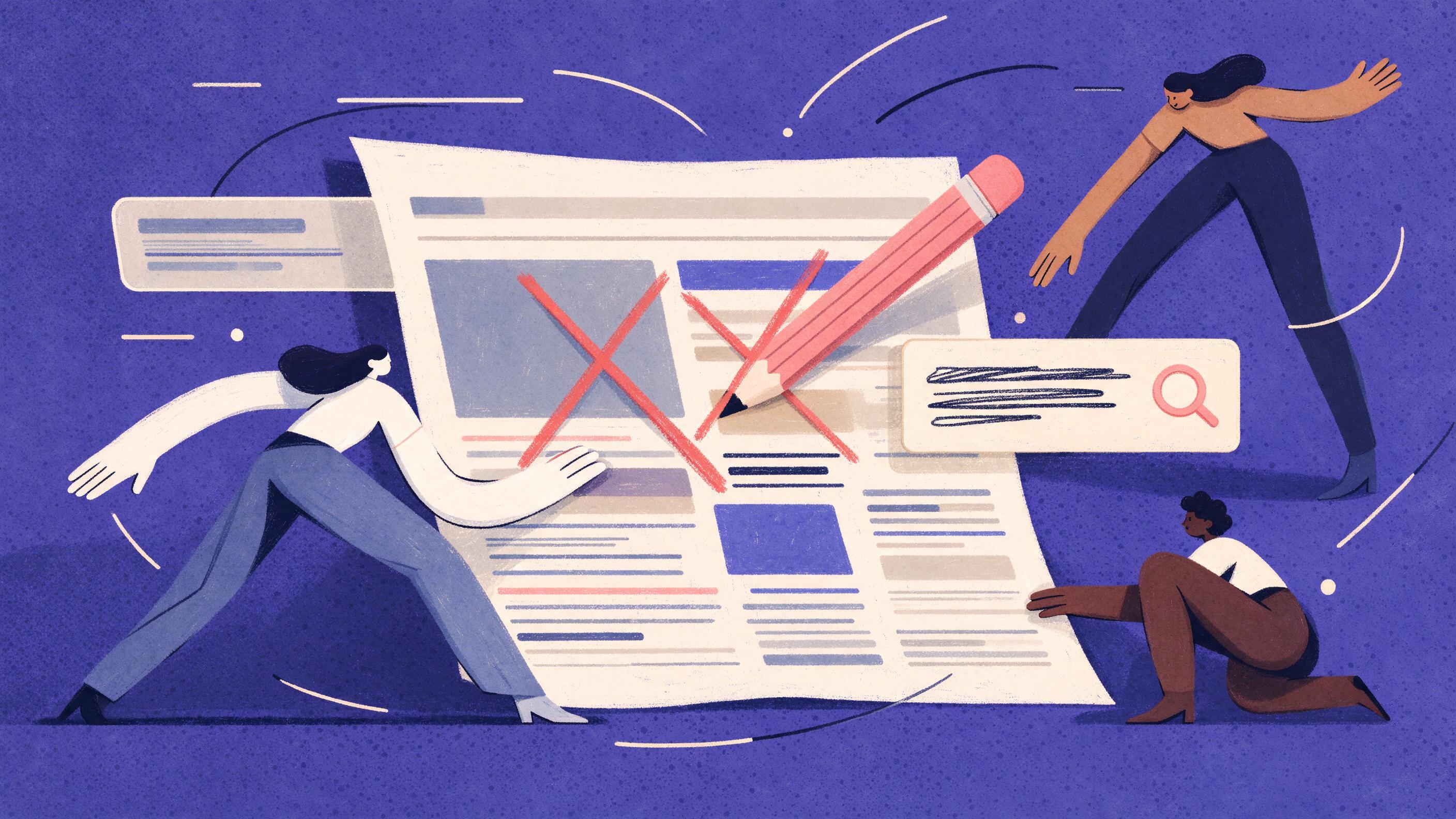
A close-up of a single printed headline on a page, with a red pencil crossing out two vague adjectives and a pun, and a handwritten note in the margin showing the exact search phrase a reader would type.
Key points

Key points

  1. 1A headline works when a reader can name the subject, the action, and the stake in one pass.
  2. 2Cut adjectives, puns, internal shorthand and vague verbs before you add anything.
  3. 3Name the specific entity, the verb that describes the action, and any number with its source.
  4. 4Check the line against the phrase a visitor would actually type: same subject, same verb, or rewrite it.

Why the headline carries the page

People scan online text; they do not read it word by word. Nielsen Norman Group found that 79 percent of test users always scanned any new page they came across, and only 16 percent read word by word (NN/G, How Users Read on the Web). Later eyetracking work over 13 years and more than 500 participants confirmed that scanning behavior stays constant even as designs change (NN/G, How People Read Online).

That finding sets the stakes for the headline. It is the one line a scanner is most likely to fixate on, and it decides whether the rest of the page gets a chance. A landing page has one job, to turn attention into action, and the visitor decides in seconds whether to stay or hit back (Wingify). A weak or vague headline loses the visitor before any of the page below it can work.

The headline also has a job downstream. In a landing page context, the headline must match the ad, email or search query that brought the visitor there, because a disconnect between what was promised and what the headline delivers costs trust (Unbounce). Unbounce's example is an ad for retirement communities that lands on a page about luxury condos, which drives visitors away (Unbounce). Wix makes the same point about intent: people who just clicked an ad have a very specific intent, so the page should give them one focused, no-fluff promise (Wix).

So the headline is not a creative flourish. It is a promise with a measurable match test.

What to cut: the four recurring leaks

Most bad headlines fail for one of four reasons. Cut these before you rewrite.

Adjectives that assert rather than show. Nielsen's research found that users detested marketese, the promotional writing style with boastful subjective claims such as "hottest ever," and that credibility suffers when users see the site exaggerate (NN/G, How Users Read on the Web). Words like powerful, seamless, revolutionary and next-generation carry no information a reader can check. They occupy the space where the specific entity should go.

Puns and cleverness. NN/G's writing guidance explicitly asks for meaningful subheadings, not "clever" ones (NN/G, How Users Read on the Web). A pun costs the reader a beat of decoding, and in that beat they may scroll. The Intuitive Writing School puts the rule bluntly: never sacrifice clarity in an attempt to be clever, because a confused reader does not click (The Intuitive Writing School).

Internal shorthand. Product codenames, project names, tier labels and abbreviations the team uses in chat mean nothing to a visitor. The headline should use the words the audience uses. Voice of customer research, meaning the exact phrases people use in reviews and support tickets, is the source for those words (Wingify). Klientboost's copy guidance says to infuse landing page copy with your customers' words (Klientboost, landing page copy).

Vague verbs. "Elevate," "unlock," "empower," "transform" and "streamline" describe a feeling, not an action. A reader cannot picture what happens. Compare "unlock your team's potential" with "move a spreadsheet with 40,000 rows into a dashboard in one step": the second tells the reader what will occur.

A quick test for each: if you delete the word, does the reader know less about the subject? If not, it was decoration.

What to name: entity, verb, number, source

A headline needs three load-bearing parts and one optional part. Name the entity, name the action, and state the stake. Add a number only when you can name its source in the same line or the subhead.

ElementBadGoodWhy it works
Entity"The platform""A 12-person bookkeeping team"Reader recognizes themselves
Action"Unlocks efficiency""closes the books in two days"A verb a reader can picture
Stake"Saves time""instead of nine"A comparison, not a claim
Number and source"Thousands of users""412 firms, from the vendor's own customer count"The source makes it checkable

Leadpages-style landing pages need their value proposition conveyed upfront, and Klientboost's value proposition guidance asks three questions of the top of any page: how it solves the reader's problem, why it beats alternatives, and what benefits the reader can expect (Klientboost, value proposition). The between-the-lines framing is useful: simple, succinct, specific, and specific means the reader has no doubt the line is for them (Between the Lines Copywriting).

A worked example, using the swap above:

  • Draft: "Unlock your team's potential with effortless bookkeeping."
  • Cut: "unlock," "potential," "effortless."
  • Name: the entity (a 12-person bookkeeping team), the action (closes the books), the stake (in two days instead of nine).
  • Final: "Close the books in two days, not nine, with a 12-person bookkeeping team."

Note what the final line does not do. It does not claim the fastest, the best or the easiest. It states a change a reader can measure against their own week.

Klientboost has a concrete example of how small an edit can be: adding the word "affordable" to a value proposition produced a 93 percent lift in conversion rate on one of its own landing pages (Klientboost, value proposition). One specific word did the work that several adjectives could not.

When the headline carries a number, the number needs a home. If the page says "cut reconciliation time by 60 percent," the body must say where that came from: an internal study of a stated number of accounts over a stated period, or a customer's own report. A number without a source is a boast wearing a decimal point.

The query check: a repeatable five-minute test

The short answer to whether a headline works is whether it shares a subject and verb with the phrase a visitor would type. Here is the drill.

  1. Write the query. Not the keyword list. The sentence a person types or says out loud when they have the problem. For example: "how do I stop my team from pasting figures into slides by hand."
  2. Extract the subject and verb. Subject: a team pasting figures by hand. Verb: stop.
  3. Extract the subject and verb from your headline. If the headline says "Reimagine your reporting workflows," the subject is nothing and the verb is "reimagine." Mismatch.
  4. Rewrite until both match. "Stop pasting figures into slides by hand."
  5. Run the three-second test. Show the headline to someone outside the team for three seconds, then ask: what is it about, what happens, and what does the reader get? If any answer is missing, the line is decoration.

This is closer to how search systems judge relevance than how a copywriter judges taste. In a search engine like Elasticsearch, a match query on a text field scores documents by how well their terms match the query terms, which is why matching the actual words a user types changes what gets returned (Elastic, match and match phrase queries). The same logic applies to a human scanner: shared terms signal "this is for you" before any decoding happens.

Message match is not only for ads. Unbounce recommends pairing each ad headline with a matching page, or using dynamic text replacement to swap the headline to match the ad that was clicked (Unbounce). Google's ad guidance makes the same demand in a tighter space: Google responsive search ads cap each headline at 30 characters and support up to 15 headlines per ad, and the guidance is to state the offer directly and match the specific theme of the ad group rather than write one generic line (Coinis). If your ad headline passes the query check and your page headline does not, you have moved the mismatch one click downstream.

Two practical notes. First, write the headline last. The Intuitive Writing School recommends writing the article first and the headline after, because the direction can change once you start drafting (The Intuitive Writing School). Second, test more than one. Klientboost lists A/B testing the copy as one of its core landing page steps (Klientboost, landing page copy), and Unbounce frames best practices as a starting point that customers then settle by experiment (Unbounce).

Putting the headline in the page around it

A named headline does more work when the elements around it confirm the promise. Unbounce recommends keeping the headline, the unique sales proposition and a strong call to action visible above the fold, and warns against cramming so much onto the screen that the call to action gets lost (Unbounce). Wix's landing page lead makes the same point about focus: give visitors one big, bold header, a CTA and three value propositions, and skip the fluff (Wix).

Social proof belongs directly under the claim, not near the footer. Mutiny's study of two landing page versions found that a version with a customer quote produced a 35 percent lift in conversions compared with a version showing company logos, and the explanation was that small and medium businesses respond to people like them describing problems like theirs (UserEvidence). CXL's guidance is that social proof works best as supporting copy near a call to action or at a specific point of friction, not as decoration (CXL).

This matters for the headline because the proof is what converts the named promise into belief. If the headline says "closes the books in two days, not nine," the testimonial beneath it should come from a bookkeeper who can say the same thing in their own words, with a number. A logo wall under that headline does less work.

There is also a formatting layer. NN/G's writing guidance calls for scannable text: highlighted keywords, meaningful subheadings, bulleted lists, one idea per paragraph, the inverted pyramid and roughly half the word count of conventional writing (NN/G, How Users Read on the Web). In a controlled comparison, the concise version measured 58 percent better usability and the scannable version 47 percent better, and a page combining several of the writing guidelines measured 124 percent better usability than the control (NN/G, How Users Read on the Web). The headline is the first scannable element, so it should read like a heading, not like a sentence trimmed to fit.

Stripe's guide adds a useful rewrite pass for the lines around the headline: go through each sentence and rewrite it to address the customer, often by starting with "you" or with a verb (Stripe). Von Restorff aside, the pattern is mechanical and fast, and it catches the "we offer" phrasing that puts the company where the reader should be.

Where a headline fits in a writing workflow

If you produce a lot of pages, the headline check is the bottleneck because it needs a real query, a real second pair of eyes and a decision. Three ways to handle the volume:

  • Write the query first. Put the visitor sentence in the brief. The headline writer then has a target rather than a blank page. Wingify recommends starting with audience and goal research before typing a word of the headline, and names two questions to answer first: who am I talking to, and what do I want them to do (Wingify).
  • Keep a query bank. Every support ticket, sales call note and review is a candidate sentence. Klientboost recommends pulling from customers' own words, and Wingify points to Reddit, G2 and support tickets as sources for exact phrasing (Klientboost, landing page copy, Wingify).
  • Review against a fixed checklist. Stripe's advice to rewrite each sentence so it addresses the customer, often starting with "you" or a verb, is a mechanical pass that catches the worst offenders quickly (Stripe).

A short checklist you can paste into a review request:

Headline review checklist
1. Does the line contain a specific entity a visitor recognizes?
2. Does it contain a verb that names what happens?
3. Is the stake stated, ideally as a comparison?
4. Is every number sourced on the page?
5. Did the head adjective, pun or internal term get cut?
6. Does the subject and verb match the visitor's query?
7. Three-second test: does an outsider name subject, action, stake?
8. Does the subhead or proof confirm the promise?

Wingify's AIDA framing is a good way to sequence the page under a named headline: attention from a clear relevant headline, interest built with a relatable problem, desire from the outcome the reader wants, and action from a single specific next step (Wingify). The headline carries the attention step, and nothing else on the page can do that job if the line fails.

When teams run this on every page, the review takes minutes and the headline stops being the place where careful work gets lost. If the bottleneck is producing the surrounding page copy, launch assets and variants at volume, a builder can carry the first draft while you own the headline decision. Quanta takes a description of the site, app, document or plan you need and has a specialist build it with you: Quanta. The headline stays your call, because it is the one line that has to match a query only you know.

Worked example: three drafts to one line

Here is the whole drill on one page, using a plausible product: a tool that reviews contracts for a legal team.

Draft 1 (clever): "Let your contracts do the talking." Subject: contracts. Verb: talking. Stake: none. A reader cannot tell what happens or why it matters. Cut.

Draft 2 (adjectival): "Powerful AI contract review for modern legal teams." Subject: contract review. Verb: none (review is a noun). Stake: none. "Powerful" and "modern" are marketese. The NN/G finding on promotional writing is the relevant precedent (NN/G, How Users Read on the Web).

Draft 3 (query-matched): "Find the 12 clauses that slow a contract review, before the client asks." Extracted query: "why does contract review take so long, what should I look for." Subject: clauses in a contract review. Verb: find. Stake: before the client asks. The number needs a source in the body: "the 12 clause types our reviewers flag most often, from an analysis of N contracts" with N and the period stated.

The check. A reader can name the subject (clauses), the action (find them) and the stake (before the client asks) in one pass. That is the test the short answer describes.

The page beneath. The subhead names the audience and the outcome; the first proof block is a quote from a reviewer who found a specific clause and can say what it saved; the first call to action sits above the fold and is the only one on the page (Unbounce, Wix). The headline's promise is confirmed, not repeated.

A note on tone, since the drill is narrow. Stripe's guide suggests varying sentence length and adding a glossy word or two, but in a headline the risk runs the other way: one polished adjective can push the line back into marketese (Stripe). Save the texture for the subhead.

FAQ

FAQ

How long should a landing page headline be?

Short enough to scan in one pass, which in practice means one clause, not two. The copywriting guidance cited here puts the ideal SEO headline at about 55 characters, and Google's ad headlines have a hard cap of 30 characters each (Between the Lines Copywriting, Coinis). The stronger rule is functional: if a reader cannot name the subject, action and stake after three seconds, cut words until they can.

Should the headline be the same as the ad headline?

It should share the subject and verb, not necessarily the exact words. Unbounce recommends creating variant pages or using dynamic text replacement so the page headline matches the ad that was clicked, because a mismatch signals a bad click (Unbounce). Wix's guidance points the same way: a landing page should carry a focused, no-fluff promise rather than a generic one (Wix).

Can a clever headline still work if it is memorable?

Only when clarity survives the cleverness. Nielsen's research found users detested marketese and that credibility suffers when a site clearly exaggerates, which limits how far a clever line can carry a page on its own (NN/G, How Users Read on the Web). A memorable line that fails the three-second test is decoration, and decoration does not earn the click.

Do numbers in headlines help or hurt?

They help when the page can source them and hurt when it cannot. A specific figure gives the scanner something to check, and the same principle underlies the split between claim and proof on a landing page, where social proof works best next to the claim it supports (CXL). Klientboost's 93 percent lift from adding "affordable" to a value proposition shows how far a single checkable word can move conversion (Klientboost, value proposition). If the body cannot say where the number came from, the number is a liability, not an asset.

How do I test a headline without a big traffic budget?

Run the query check and the three-second test first, because they cost nothing and catch most failures. After that, test two named variants against each other rather than a clever one against a clear one; Klientboost lists A/B testing as a core step in landing page copy, and Unbounce frames best practices as a starting point that customers settle by experiment (Klientboost, landing page copy, Unbounce). Small samples on a clear, specific pair tell you more than large samples on a vague one.

Sources

Sources

  1. How Users Read on the Web - NN/G
  2. How People Read Online: New and Old Findings - NN/G
  3. Landing Page Copywriting: A Step-by-Step Guide to Conversions
  4. Landing Page Best Practices To Create High-Converting Pages
  5. 15 landing page best practices, plus design tips - Wix.com
  6. 22 Powerful Headline Examples (+ How to Write Ones That ...
  7. How To Write Landing Page Copy That Converts In 13 Steps
  8. 17 Landing Page Value Proposition Examples To Skyrocket Conversions
  9. How To Write Headlines That Make People Want To Keep ...
  10. Elasticsearch Match Query & Match Phrase Query - S1E11
  11. How to Write Google Ad Headlines That Actually Get Clicks
  12. Increase Landing Page Conversions With Three Types of Social Proof
  13. Social Proof: Definition, Types, Examples & How to Work With It - CXL
  14. Writing copy for landing pages - Stripe
About the author

About the author

Antonio Evans
Antonio Evans

Antonio Evans is the founder of Quanta Intelligence and a fractional CTO who builds HIPAA-ready AI systems for health and life-science companies. Before that he was technical co-founder of FriendsEAT for twenty years, CEO of Socialdraft, and a data engineer at IBM. Antonio lives with his dog Santino in Lisbon, Portugal.

All articles